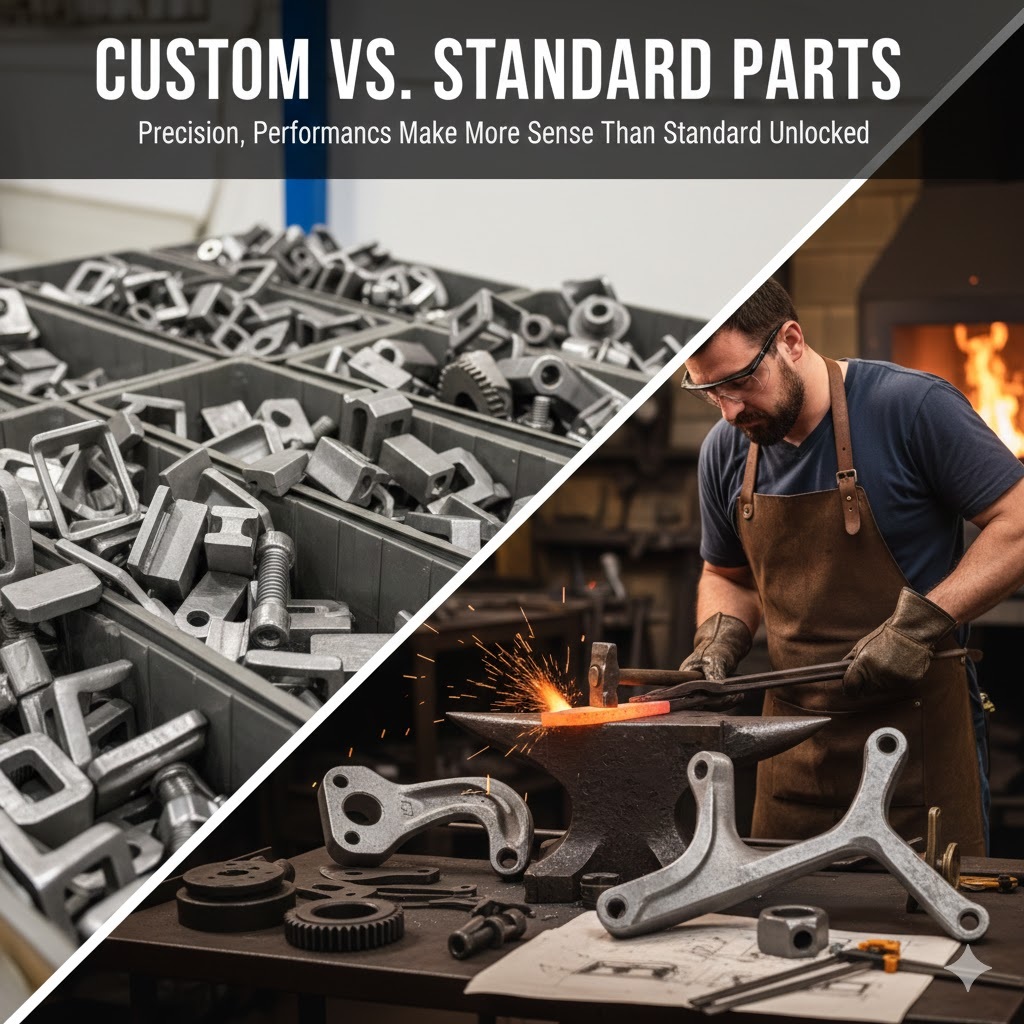
When Custom Forging Components Make More Sense Than Standard Parts
Standard parts keep industries moving. They are easy to source, predictable in cost, and fast to deploy. But industrial systems rarely remain standard for long. Loads increase, operating windows narrow, environments turn harsher, and margins for failure disappear. At that point, off-the-shelf solutions stop being efficient and start becoming liabilities. This is where custom forging components begin to make more sense—not as an upgrade, but as a correction to real-world operating demands.
The decision to move away from standard parts is rarely driven by ambition. It is driven by experience.
Where Standard Parts Start Falling Short
Standard components are designed for averages. They assume typical loads, typical temperatures, and typical duty cycles. That assumption holds only until it does not.
Industrial systems evolve. Equipment gets repurposed. Throughput increases. Fluids change. Vibration levels rise. When standard parts operate outside their original design envelope, performance degrades quietly. Fatigue life shortens. Maintenance intervals shrink. Failures become more frequent, even when specifications appear technically compliant.
Custom forging components step in when systems demand behavior, not just compliance.
Load Paths Are Never Generic
Every machine carries load in its own way. Geometry, alignment, mounting constraints, and dynamic forces shape how stress travels through a component.
Standard parts apply generic geometry to specific load paths. This mismatch creates stress concentrations where none were intended. Forging allows geometry and grain flow to align with actual service loads. Metal flows into shape under compression, creating directional strength exactly where it is needed.
This alignment is not cosmetic. It directly improves fatigue resistance and crack suppression. In applications where cyclic loading dominates failure modes, custom forging components deliver performance gains that cannot be replicated through machining or material substitution alone.
Fatigue Life Is Designed, Not Assumed
Fatigue failure rarely originates from overload. It originates from repetition.
Custom forging allows engineers to design fatigue resistance into the component itself. Fillet radii, transitions, section thickness, and grain orientation are all tuned together. The result is not just higher strength, but longer usable life under real operating cycles.
Standard components rely on conservative assumptions to survive unknown applications. That conservatism often leads to unnecessary mass or insufficient fatigue margin. Custom forging components remove that compromise by matching structure to reality.
Material Selection Becomes a Performance Tool
Standard parts limit material choice. Availability drives selection, not application need.
Custom forging opens access to material grades optimized for specific environments—high-temperature stability, corrosion resistance, impact toughness, or wear behavior. Heat treatment cycles can be matched precisely to geometry and service conditions.
This material-process alignment ensures mechanical properties remain consistent throughout the component, not just on test coupons. For industries facing extreme conditions, custom forging components transform material choice from constraint into advantage.
Dimensional Freedom Without Structural Penalty
Machining creates shape by removing material. Forging creates shape by moving material.
Custom forging allows complex geometry without severing internal grain flow. Load-bearing regions remain intact internally, even when external profiles become application-specific. This enables integration of features that would weaken machined parts or complicate cast designs.
The result is dimensional freedom paired with structural integrity. This balance is difficult to achieve with standard components, regardless of machining precision.
Reducing System-Level Risk, Not Just Part Failure
Component failure rarely occurs in isolation. When a critical part fails, collateral damage follows—bearings, housings, shafts, seals, and downtime.
Custom forging components reduce this cascading risk by behaving predictably under stress. Progressive deformation replaces sudden fracture. Crack initiation slows. Maintenance becomes planned rather than reactive.
In high-value systems, reducing uncertainty matters more than minimizing initial cost.
Where Custom Forging Delivers Measurable Value
Certain operating scenarios consistently justify the shift away from standard parts:
| Operating Condition | Standard Parts | Custom Forged Components |
| High cyclic loading | Early fatigue onset | Extended fatigue life |
| Elevated temperature | Property degradation | Thermal stability |
| Misalignment or vibration | Stress concentration | Load redistribution |
| Weight-sensitive systems | Excess mass | Optimized strength-to-weight |
| Long service intervals | Frequent inspection | Reduced maintenance |
| Failure tolerance | Low | Controlled failure behavior |
In these conditions, custom forging components stop being optional and start becoming necessary.
Engineering Collaboration Changes the Outcome
Custom forging works best when manufacturing capability influences design decisions early.
Forging-specific design considers material flow, die constraints, deformation behavior, and heat treatment from the start. This integration eliminates late-stage redesigns and improves first-pass validation success.
Sendura Forge Pvt. Ltd operate within this collaborative framework, where engineering input and forging expertise shape components that are purpose-built rather than adapted from standard catalogs.
Production Consistency at Scale
Custom does not mean inconsistent.
Once a forging process is established, repeatability becomes a strength. Controlled deformation parameters, die design, and thermal cycles produce consistent mechanical properties across production batches.
Standard parts may vary by supplier, batch, or sourcing region. Custom forging components lock performance into the process itself, reducing variability that inspection alone cannot eliminate.
Long-Term Cost Reality
Standard parts appear economical at purchase. Custom components reveal their value over time.
Reduced downtime, extended service life, fewer failures, and lower inspection frequency change the cost equation. When systems operate continuously or failure carries high consequence, lifecycle cost outweighs unit price.
Custom forging components protect not only equipment, but operational continuity.
When Custom Forging Is the Rational Choice
Custom forging is not about overengineering. It is about alignment—between design intent and operating reality.
When systems operate beyond averages, when failure margins shrink, and when reliability defines competitiveness, standard parts stop making sense. Custom forging components offer a way to embed performance directly into the metal, where no adjustment or workaround can reach later.
When Standard Parts Are Worse Than No Parts at All
In real industrial settings, standard components sometimes perform well enough—but only until they don’t. Standard parts are designed to fit a wide range of applications, but in doing so they assume conditions that are often far removed from reality. Operating realities—misalignment, thermal gradients, pressure spikes, vibration, contamination, and load variations—interact in complex ways that off-the-shelf parts cannot account for. When these hidden stresses combine, the result is not gradual wear, but unexpected and sometimes catastrophic failure.
Custom forging components respond to this complexity because they are shaped around actual service conditions rather than generic specifications. Instead of assuming a component will “likely” survive a duty cycle, custom forging ensures the metal itself is prepared for the specific loads, orientations, and environmental factors it will face. This means failure does not come as a surprise—it is engineered out.
The table below highlights how standard parts and custom forged designs behave under unpredictable, real-world stress patterns:
| Performance Factor | Standard Parts | Custom Forged Components |
| Hidden defect risk | Moderate to high | Minimal due to process control |
| Behavior under multi-axial stress | Unpredictable | Designed for direction-specific loads |
| Response to thermal cycles | Varies widely | Dimensionally stable and fatigue resistant |
| Tolerance to assembly variation | Sensitive | More forgiving thanks to tailored geometry |
| Failure mode predictability | Uncertain | Progressive and manageable |
| Overall system impact when failure occurs | Severe | Localized and controlled |
In situations where unexpected loads emerge—such as shock loading, eccentric forces from misalignment, transient thermal excursions, or combined stress effects—standard components often conceal weaknesses until they suddenly fail. Custom forging components make such surprises far less likely because the forging process itself consolidates metal, improves continuity, and eliminates microstructural weaknesses that standard parts often inherit.
Conclusion
Industrial systems do not fail because components are weak. They fail because components are mismatched to reality.
Custom forging replaces assumption with intent. Geometry follows load. Grain flow follows stress. Material behavior follows application demand. In environments where reliability, fatigue life, and predictability matter more than catalog convenience, custom forging components become the logical and responsible choice—not as an upgrade, but as the correct solution from the start.