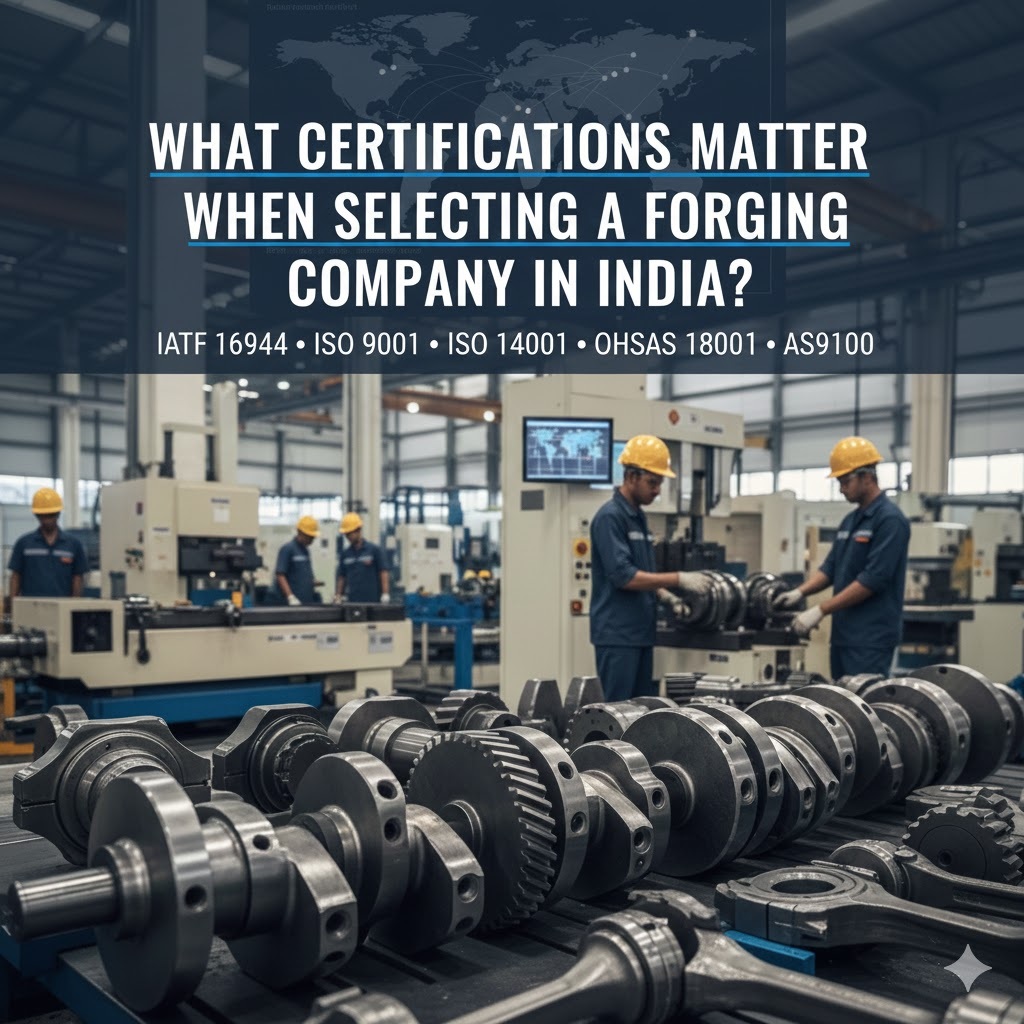
What Certifications Matter When Selecting a Forging Company in India?
Forging does not forgive disorder. Heat, force, time, and material collide inside a narrow operating window. Step outside that window and defects appear quietly—sometimes months later, sometimes after thousands of vehicles reach the road. Certifications exist because memory, experience, and intent are not enough. They exist to lock discipline into the system, especially when pressure rises and shortcuts tempt.
Selecting a forging company in India is therefore not a branding exercise. It is a risk decision. Certifications reveal whether risk is managed structurally or merely postponed.
Certification Is Evidence of Control Under Stress
In forging, the real test is not when machines run clean and volumes are stable. The test arrives during die wear, billet chemistry drift, furnace imbalance, operator rotation, and urgent delivery schedules. Certifications force a plant to behave predictably during those moments.
A certified forging operation demonstrates that decisions are made by process logic rather than urgency. That distinction defines whether a supplier survives OEM scrutiny.
ISO 9001: Discipline That Replaces Dependency on Individuals
ISO 9001 draws a hard line between habit-driven production and system-driven production. Forging operations depend on dozens of variables—billet temperature, deformation rate, lubrication timing, die condition, trimming consistency, inspection flow. ISO 9001 demands these variables be governed, not remembered.
Documented processes, internal audits, corrective action closure, and management accountability form the backbone. Without this structure, consistency relies on individuals. Individuals leave. Systems remain.
Any forging company in India without ISO 9001 operates with invisible fragility.
IATF 16949: Automotive Reality Check
Automotive forging is one of the toughest industries out there. It’s parts that are subject to cycles of strain, vibration and temperature fluctuations – 24/7, for years on end. IATF 16949 exists to make sure that suppliers can consistently meet the zero-defect expectations that come with long-term production.
This certification isn’t just about making sure a forging plant does all the right quality planning and statistical control – it’s also about how well they handle things when things inevitably go wrong. Not so much about hiding those mistakes, but about dealing with them in a structured way.
OEMs interpret IATF 16949 as proof that a forging company in India understands automotive consequences, not just automotive drawings.
ISO 14001: Environmental Control as Process Intelligence
Forging consumes fuel aggressively and generates scale, emissions, and waste. ISO 14001 establishes structured environmental management across energy usage, emissions control, and waste handling.
Beyond compliance, environmental discipline reflects operational maturity. Plants that measure energy control heat better. Plants that manage waste manage cleanliness better. Cleanliness influences inspection accuracy and safety.
OEMs increasingly associate ISO 14001 with long-term stability rather than short-term compliance.
ISO 45001: Safety Systems Reflect Production Stability
Forging environments carry inherent risk—heat, pressure, mass, speed. ISO 45001 enforces structured safety management that reduces incidents, downtime, and workforce instability.
Stable manpower supports stable production. Unstable production destroys delivery confidence. OEMs understand this link clearly.
A forging company in India with ISO 45001 demonstrates that production continuity is treated as a system, not luck.
Metallurgical and Heat Treatment Certifications: Where Performance Is Decided
Forged strength originates in grain flow and thermal treatment. Shape alone means nothing without controlled microstructure. Metallurgical certifications confirm control over hardness, phase transformation, grain refinement, and fatigue behavior.
OEMs scrutinize whether heat treatment is controlled internally or outsourced blindly. Internal certified control shortens corrective loops and improves predictability during failure analysis.
Forging suppliers lacking certified metallurgical systems operate with hidden risk that surfaces only after field exposure.
Calibration and Measurement Control: Protecting Dimensional Truth
Forging tolerances are tight for a reason. Dimensional drift affects assembly fit, bearing life, and fatigue initiation. Calibration certification ensures that gauges, testers, and inspection equipment deliver consistent truth.
False acceptance damages reliability. False rejection inflates cost. OEMs demand evidence that measurement systems are disciplined, not assumed.
A forging company in India with structured calibration practices protects downstream processes from silent error.
OEM-Specific Certifications and Continuous Approval
Global OEMs impose proprietary requirements beyond international standards. These include layered audits, traceability depth, escalation protocols, and continuous improvement targets. These requirements evolve constantly.
Suppliers that adapt survive. Suppliers that resist fade quickly. OEM approvals earned across multiple platforms reflect sustained discipline under observation, not one-time audit success.
Certification Depth Versus Decorative Compliance
Certificates displayed on walls do not impress OEM auditors. Behavior does. Superficial compliance collapses under volume, tool wear, and schedule pressure. Deep compliance absorbs stress and continues delivering.
Auditors detect superficial systems immediately—documents that exist without shop-floor alignment fail under questioning.
Certification Discipline in Practice: Sendura Forge Pvt. Ltd
Sendura Forge Pvt. Ltd reflects certification applied as operational behavior rather than symbolic compliance. Structured quality systems, controlled forging parameters, and disciplined workflows align certification intent with daily execution. Such alignment supports consistency across demanding automotive and industrial applications.
How OEMs Use Certification During Supplier Selection
Certification acts as an entry gate. It reduces unknowns before deeper evaluation begins. After entry, OEMs examine process audits, pilot production, capability indices, and delivery history.
Suppliers aligned with relevant certifications progress faster through approval cycles. Those without face prolonged scrutiny and elevated risk classification.
For a forging company in India, certification alignment directly influences sourcing velocity.
Certification as Risk Containment
Forged components carry safety, financial, and reputational consequences. Certification systems reduce uncertainty by enforcing structure, traceability, and accountability. Reduced uncertainty often outweighs marginal price differences in OEM sourcing decisions.
Risk containment drives long-term supplier preference.
How Certifications Directly Reduce OEM Cost, Delays, and Liability
OEMs don’t value certifications because they look good in supplier presentations. They value them because certifications collapse uncertainty. In forging, uncertainty always converts into cost—through rework, line stoppages, warranty claims, or recall exposure.
Well-implemented certifications change how a forging company in India behaves under real production pressure. They shorten reaction time when deviations occur, prevent repeat failures, and reduce the number of escalation loops between supplier and OEM. That operational effect matters more than the certificate itself.
The table below connects specific certifications to the exact OEM risks they help contain—a link suppliers often overlook but buyers always calculate.
| Certification | OEM Risk Without It | How the Certification Contains That Risk |
| ISO 9001 | Process drift over long production runs | Forces documented control of forging parameters and change management |
| IATF 16949 | Line stoppage due to part failure | Enforces preventive risk analysis and structured corrective actions |
| Heat Treatment Certification | Fatigue failure after field use | Ensures repeatable microstructure and hardness consistency |
| Calibration & MSA | Assembly misfit and premature wear | Protects dimensional accuracy and measurement reliability |
| ISO 14001 | Regulatory or supply disruption | Stabilizes energy use, emissions, and waste handling |
| ISO 45001 | Production interruptions due to incidents | Reduces downtime and workforce instability |
| OEM-Specific Approvals | Slow sourcing decisions | Aligns supplier behavior with platform-level expectations |
From an OEM perspective, each missing or weak certification adds a risk premium—sometimes invisible, sometimes explicit. That premium appears as smaller order volumes, longer trial periods, or tighter commercial terms.
A forging company in India that aligns certifications with daily decision-making doesn’t just meet requirements—it reduces friction across engineering, quality, purchasing, and production teams. That reduction is what converts initial approval into long-term sourcing.
Conclusion
Certifications determine whether a forging operation deserves trust under sustained pressure. ISO 9001 establishes foundational discipline. IATF 16949 confirms automotive readiness. ISO 14001 and ISO 45001 signal environmental and safety maturity. Metallurgical and calibration certifications protect performance integrity. A forging company in India aligned with these systems demonstrates readiness for high-consequence manufacturing where failure is permanent. In global forging supply chains, survival belongs to controlled systems—not confident claims.