
Internet of Things (IoT) Sensor: The Backbone of a Connected World
Introduction
The Internet of Things (IoT) has rapidly evolved from a futuristic concept into an integral part of modern technology. Today, billions of connected devices seamlessly exchange data, automate processes, and enable smarter decision-making across industries. At the core of this transformation lies one essential component: the IoT sensor. These compact yet powerful devices capture real-world information and convert it into digital signals that IoT systems can process, analyze, and act upon. Understanding how IoT sensors work, the types available, and their impact across different sectors is crucial for anyone navigating the landscape of connected technologies.
Definition
An Internet of Things (IoT) sensor is a small, connected device that detects and measures physical conditions – such as temperature, motion, light, pressure, or humidity – and sends that data over a network to other systems for processing or action. These sensors enable real-time monitoring, automation, and data-driven decision-making by allowing everyday objects to communicate and interact through the internet.
What Is an IoT Sensor?
An IoT sensor is a device that detects changes in environmental conditions and converts them into measurable data that can be transmitted and interpreted digitally. The data gathered may include temperature, motion, humidity, pressure, gas levels, sound, and countless other variables. IoT sensors are typically integrated with communication modules – such as Wi-Fi, Bluetooth Low Energy (BLE), LoRaWAN, or cellular – to send data to cloud platforms or local edge devices for processing. These sensors serve as the eyes and ears of IoT ecosystems. Without them, smart cities, connected homes, industrial automation systems, and wearable technologies would not be able to function intelligently or autonomously.
How IoT Sensors Work
IoT sensors follow a clear, streamlined workflow:
- Detection – The sensor identifies physical changes within its environment.
- Signal Conversion – These changes are transformed into electrical signals.
- Data Processing – A built-in microcontroller or edge-computing module may pre-process data.
- Transmission – Data is sent to cloud platforms or gateways through a communication protocol.
- Analysis and Action – Software applications analyze data to inform insights or trigger automated responses.
This process happens continuously, often in real-time, enabling systems to react instantly to changes and improving overall operational efficiency.
Types of IoT Sensors
IoT sensors come in many forms, each designed for specific tasks. Some of the most widely used categories include:
1. Temperature Sensors
These measure ambient or surface temperature. They are used in HVAC systems, industrial equipment monitoring, food storage, and agriculture. Their ability to detect small fluctuations makes them essential in environments where precision is critical.
2. Proximity Sensors
Without making physical contact, proximity sensors may identify the presence of objects or people. They are commonly found in retail for automated checkouts, automotive parking systems, and smart lighting.
3. Motion Sensors
Motion sensors, including accelerometers and gyroscopes, track movement, tilt, and vibration. They power everything from fitness wearables to industrial vibration monitoring systems that predict maintenance needs.
4. Environmental Sensors
These measure humidity, air quality, gas concentration, and atmospheric pressure. Smart city projects often rely on such sensors to monitor pollution levels or detect hazardous gas leaks.
5. Optical Sensors
Optical sensors measure light intensity or color variations. They are used in smart streetlights, indoor farming, smartphone brightness control, and automated security systems.
6. Pressure Sensors
Pressure sensors measure force, fluid levels, or atmospheric pressure. Industries such as aviation, automotive, and manufacturing depend on them for critical operations and safety.
7. Biosensors
Biosensors detect chemical or biological elements such as glucose levels, heart rate, or sweat composition. These sensors have revolutionized healthcare by enabling continuous, non-invasive health monitoring.
8. RFID and NFC Sensors
These sensors are used for tracking, authentication, and asset management. Logistics companies depend heavily on RFID tags to monitor goods throughout supply chains.
Applications of IoT Sensors Across Industries
IoT sensors have become foundational across major sectors, enabling automation, improving safety, and enhancing performance.
Smart Homes:
IoT sensors elevate home automation with capabilities such as motion-activated lighting, energy management through smart thermostats, security with door/window sensors, and health monitoring via smart appliances.
Healthcare:
Wearable biosensors track vital signs in real time, enabling remote patient monitoring and early detection of medical issues. Hospitals use IoT sensors for equipment tracking and environmental control to maintain sterile conditions.
Industrial IoT (IIoT):
Factories use IoT sensors for predictive maintenance, production optimization, and worker safety. Sensors detect vibration, temperature, or pressure abnormalities in machines to prevent breakdowns and reduce downtime.
Agriculture:
Precision farming relies on soil moisture sensors, weather stations, and livestock trackers to optimize irrigation, conserve resources, and improve crop yields. Farmers gain access to real-time data that supports better planning and sustainability.
Smart Cities:
From traffic management and smart parking to water distribution and waste collection, IoT sensors help cities operate more efficiently. Environmental monitoring sensors provide data for cleaner, healthier living environments.
Automotive:
Modern vehicles use dozens of sensors to improve functionality, safety, and automation. From tire pressure sensors to collision detection systems, these technologies are the foundation for advanced driver-assistance systems (ADAS) and future autonomous vehicles.
Challenges and Considerations in IoT Sensor Deployment
While IoT sensors offer immense value, their widespread deployment comes with challenges:
- Security Risks: Sensors can be targets for cyberattacks if not properly secured.
- Power Consumption: Battery-operated sensors must balance performance with energy efficiency.
- Data Overload: Large sensor networks produce massive amounts of data that require effective analytics.
- Interoperability: Devices from different manufacturers must communicate smoothly.
- Environmental Durability: Sensors may need protection from extreme temperatures, dust, moisture, or vibration depending on the use case.
Addressing these challenges is essential for building reliable, scalable IoT ecosystems.
The Future of IoT Sensors
IoT sensor technology continues to evolve rapidly. Future trends include:
- Miniaturization: Sensors are becoming smaller and more efficient, enabling new applications in wearables and biotech.
- Edge AI Integration: Combining sensors with artificial intelligence at the edge allows for real-time onboard processing.
- Energy Harvesting Sensors: Innovations allow sensors to draw power from motion, light, or heat, reducing reliance on batteries.
- More Autonomous Systems: As sensors become smarter, IoT devices will operate with greater independence and accuracy.
IoT sensors will continue to drive advancements in automation, personalization, and sustainability, shaping the technological landscape for years to come.
Growth Rate of Internet of Things (IoT) Sensor Market
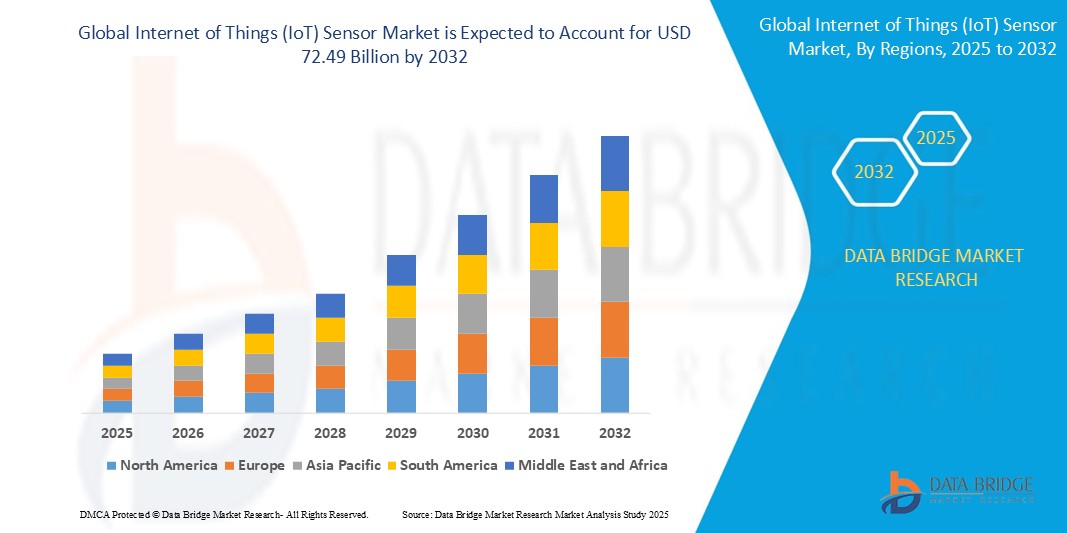
According to Data Bridge Market Research, the internet of things (IoT) sensor market was estimated to be worth USD 13.64 billion in 2024 and is projected to grow at a compound annual growth rate (CAGR) of 23.22% to reach USD 72.49 billion by 2032.
Learn More: https://www.databridgemarketresearch.com/reports/global-iot-sensors-market
Conclusion
IoT sensors are the building blocks of the connected world. Their ability to capture, transmit, and interpret real-world data enables smarter decisions, greater efficiency, and innovative solutions across industries. As the IoT ecosystem expands and sensor technologies advance, their role becomes even more vital. They not only power the devices we interact with daily but also pave the way for intelligent systems that will define the future of digital transformation.