
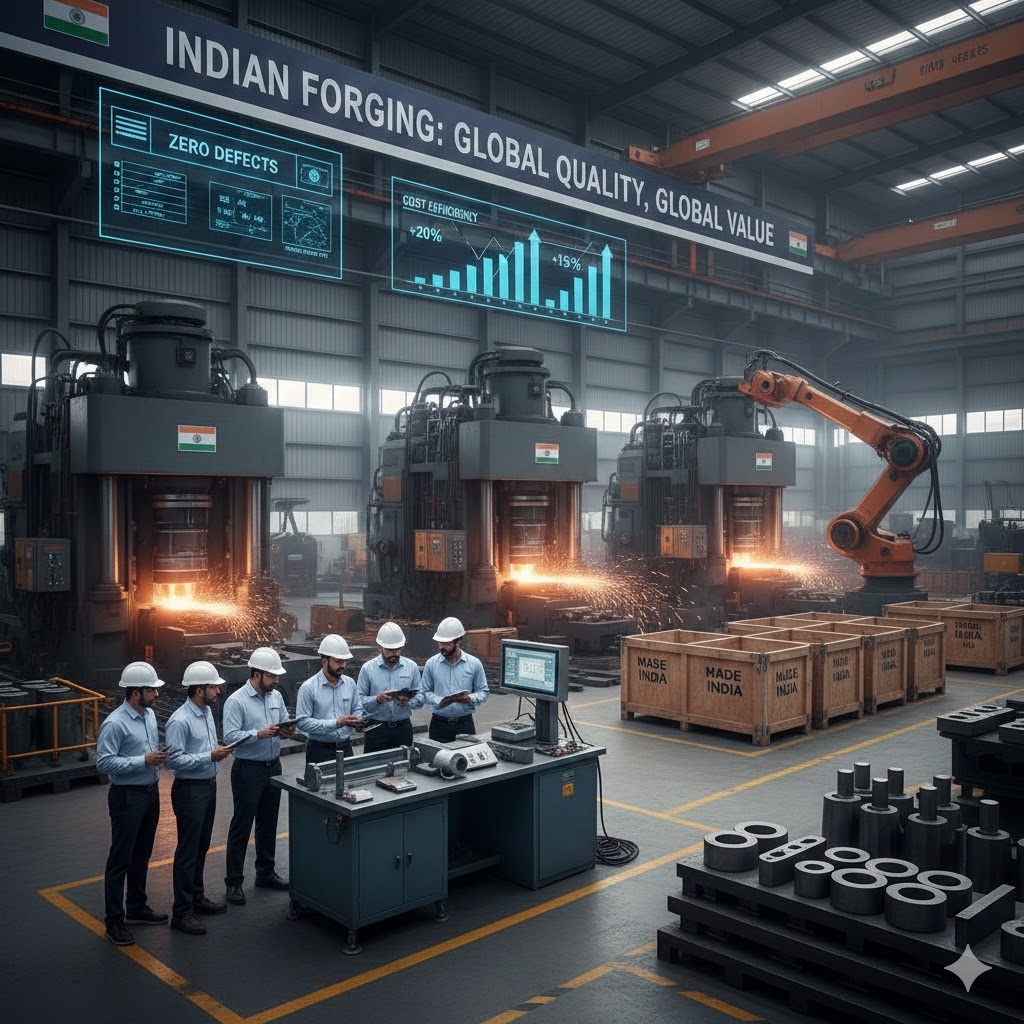
How Indian Forging Companies Are Competing with Global Manufacturers on Quality & Cost
The world industrial scene is changing dramatically. Year after year, India’s factories once carried a label – low wages, basic goods rolling out nonstop. Yet by 2026, things shifted under the surface. Precision now matters most, machines talk through networks, green practices shape decisions behind closed doors. Those handling purchases or running projects? They’re not just scanning price tags anymore. What counts today: durability woven into tech strength, trust built over time, performance tested beyond paper claims.
India has become the second-largest producer of forgings in the world after China. But production volume is just a number that looks good on the surface; the real issue is how close the quality of Indian products is getting to Western and Japanese ones, which have been dominant for years. This article delves into the details of how Indian forging companies have been successful globally and offers insightful tips for a critical sourcing decision.
The Technology Gap: Closing the Loop on Precision
One of the most outstanding features of the current market is the almost universal use of closed-die (impression-die) forging. While open-die forging, which is characterized by fewer constraints, is suitable for bigger and simpler parts, closed-die forging enables the manufacturing of complex shapes with a high degree of accuracy. This is especially important in the aerospace and automotive sectors where a minute fraction of a millimeter determines whether a component will be high-performing or will fail disastrously.
Simulation and Predictive Engineering
Top-tier Indian manufacturing environments no longer figure out the best way through “trial and error.” The foremost companies now have at their disposal high-end forging simulation software. When a virtual copy of the forging process is made, it is possible for the engineers to predict the flow of the metal, distribution of heat, and occurrence of stress points without actually making a single die.
- Pro Tip: Before committing to a supplier, request their simulation data. A company that can demonstrate a reduction in the defect rate by 20-25% through pre-production modeling is definitely a partner who will help you greatly cut the costs of rejected batches as well as “hidden” quality problems.
Material Science and Metallurgy
Material requirements for the industry have altered considerably as a result of the transition to Electric Vehicles (EVs) and the demand for lightweight aerospace parts. While carbon steel is still the preferred choice mainly due to its strength and ease of machining, there is an enormous increase in the forging of:
- Aluminum Alloys: Crucial in lowering the weight of vehicles and thereby increasing the range of an EV battery.
- Titanium and Superalloys: Needed for very high heat and pressure conditions in aerospace and power generation.
The Strategic Cost Advantage: Efficiency Over Labor
Many people wrongly think that the reason behind India’s cost advantage is mainly from the fact that the wages are lower. The truth is that the advantage in 2026 is the result of higher efficiency of the operations as well as vertical integration.
- Fully Finished Components: One of the most dramatic changes observed recently in the Indian market is the emergence of parts that are “ready-to-assemble.” Some of the top Indian forging companies can now provide heat treatment, precision CNC machining, and surface coating together in the same location by just one supplier. When you eliminate the process of sending raw forgings out to a third-party machine shop, you are basically cutting down logistics costs, getting a shorter turnover time, and, at the same time, consolidating the responsibility for quality.
- Energy Optimization: Inherent to forging is its possession of being an energy-intensive operation. Indian companies, therefore, had to considerably expand their investments in energy-efficient induction heating and waste-heat recovery systems, to name a few. These costs are amortized over the production of a large number of pieces, thus per-part energy costs are kept low. This is why manufacturers can keep the prices steady even when there is volatility in the global energy markets.
- Backed by India’s Production-Linked Incentive plans, domestic firms now get help putting money into new machinery. Because of this push, factories can buy powerful, large-scale presses once out of reach. With these tools in place, making tough parts for oil, gas, and green power projects happens here instead. Not long ago, those pieces had to come from European suppliers.
Sourcing strategically
Choosing a forging partner in an extremely competitive environment requires more than simply checking a price. Below is a quality-based framework that assesses potential partners to ensure they meet global standards.
- Check Certifications by Tier Level
- A stamp of approval often kicks things off in heavy industry.
- Aerospace and defense face strict demands under AS9100D.
- A fresh push in business standards comes from ISO 14001. This framework guides how companies manage their environmental impact. As global attention grows on ESG matters – covering the planet, people, and leadership practices – it holds more weight. Firms across borders now see it as a key piece in proving responsible operations. Its role expands where accountability meets action.
2. Assessing “Near-Net Shape” Capabilities
“Near-net shape” refers to a forging that is extremely close to the finished part size and therefore requires minimal machining. The advantages of a forging that is close to the finished part include:
- Less Material Waste: This is especially critical when handling costly materials.
- Shorter Cycle Times: Time to market is accelerated for your project.
- Professional Tip: When you find that a supplier has quoted a price that is suspiciously low, check the “machining allowance.” If they are still leaving a lot of material in excess, the money that you will have to spend on post-processing will most likely eliminate any savings that you initially had.
3. Digital Transparency and Traceability
In my opinion, visibility today is just as important as the product itself. The finest forging companies India has at present have transformed their use of technology by adopting Cloud-based Manufacturing Execution Systems (MES). This enables customers to monitor their orders live, right from the raw material heat number to the final inspection stage.
- Look for: Recording data pertaining to heat treatment cycles live. The absence of a digital record of the temperature and duration of a heat treatment batch raises questions about the consistency of the company’s work.
Sustainability: The New Competitive Frontier
Concern for sustainability has long been merely one of the company’s social responsibility initiatives (CSR), now it is essential for the company’s survival. Manufacturers worldwide are confronted with increasingly stringent demands to divulge the carbon footprint of their entire supply chain (i.e., Scope 3 emissions).
Indian forging manufacturers are taking the initiative through component circularity, which involves a greater use of recycled scrap metals and generation of plant power from renewable energy sources. Some companies have achieved a 30% reduction in their carbon intensity over the past 5 years. Choosing to procure from a green forge is a preemptive strategizing of your supply chain to be insulated from upcoming carbon taxes and tighter international trade regulations.
Navigating the Challenges: Infrastructure and Logistics
Although the market’s technical capability ranks among the best globally, it is always good to be realistic when it comes to logistics. India’s infrastructure is rapidly developing under the National Logistics Policy which is targeted towards lowering logistics costs from 14% of GDP to below 10%. Nevertheless, there are some issues such as:
- Transit Times: Despite the highly efficient operation of ports such as Mundra and JNPT, the inland transportation remains exposed to disruptions caused by weather conditions which are seasonal.
- Smart Tip: For about half a year of the initial partnership, it would be prudent to fact in a 10-15% “time buffer” within your supply chain so that you can cater for any logistical issues that may be encountered.
The Global Comparison: Why India?
When comparing forging companies India has in store against those in other emerging or developed markets few fundamental factors that stand out:
- Language and Legal Framework: Just making it easy to get things done because everybody speaks the same language (English) and also the legal system is based on being common law making it very simple to enforce contracts.
- Every year, countless new engineers enter the workforce – many specialize in materials or product design. These skilled professionals often collaborate closely with research teams. A strong local base means finding experts isn’t difficult. Working together, they refine component layouts so production runs smoothly. Their input helps shape parts that are simpler to build without losing function. This kind of support grows naturally from deep educational output across technical fields.
- When everything else froze during the pandemic, India’s factories kept moving. Though global supply chains collapsed, local producers found ways through. Instead of halting, many adapted overnight. While others waited, these operations shifted gears quietly. Even under pressure, output never fully stopped. Through chaos, consistency held firm.
The Final Takeaway: Trust the Tech, Not Just the Price
Finding a partner that can mitigate your risks and at the same time increase your margin is the ultimate goal of sourcing. There is such a degree of maturity in the Indian forging sector that it no longer remains a “budget” option but rather a hub of excellence for performance engineering.
Here is the Actionable Checklist for Your Consideration:
- Start by asking for a digital checkup. Does your system show output as it happens? Watch how numbers update while work moves forward.
- Testing methods – do they run ultrasonic checks here? What about magnetic particle inspections, handled locally?
- Look into how much control they have over production. Can they actually make a complete machined component? Or do they just handle basic shaping tasks without finishing touches?
- Start by asking where the steel comes from. The origin shapes everything after. Trace it back to the source – not later, but first. Ingot quality sets the baseline, nothing else can fix a weak foundation.
To be honest, the global market is too competitive to put up with anything “good enough.” By opting for one of the best forging companies India has to offer as your partner, you are not only ordering a component, but you are also buying into a technologically advanced, cost-efficient, and environmentally friendly supply chain.
Look, Indian forgings have been powering the world ever since the gears of a German luxury car and the landing gear of a commercial jet were the products of India. The question is no longer if Indian manufacturers can compete—but if your current supply chain can afford to ignore them.
India is the direction setting move. This means acting with due diligence, putting a focus on the technical specifications, and being ready for a long-term partnership. On the other hand, for those who got it right, the benefits in terms of quality and cost are unmissable. It is now the time for you to check the standards, examine the technology, and secure your project’s future.